Gynecomastia vs Fat: How to Tell the Difference
Chest tissue that doesn’t respond to diet and exercise is often the result of gynecomastia rather than ordinary fat. The gynecomastia vs fat distinction matters because the treatment approaches are completely different. Chest fat vs gyno differences are detectable through simple physical examination: gynecomastia involves actual glandular breast tissue that feels firm and rubbery, while chest fat is soft and compressible. Gyno vs fat distinction also shows up in how each responds to weight loss—chest fat reduces with overall fat loss, while gynecomastia does not. Gynecomastia or fat is the question that sends many men to physicians, and knowing which you’re dealing with determines whether you need surgery or simply a better training and diet program. A fat chest from subcutaneous fat can be addressed through lifestyle changes; true gynecomastia requires medical evaluation.
What gynecomastia actually is
Gynecomastia is the benign proliferation of glandular breast tissue in males. It’s caused by an imbalance between estrogen and testosterone activity—either elevated estrogen, reduced testosterone, or increased sensitivity of breast tissue to estrogen. It occurs at predictable life stages: in newborns (from maternal estrogen), during puberty (from the hormonal flux of adolescence), and in older men (from declining testosterone). Medications including spironolactone, certain antihypertensives, antifungals, anabolic steroids, and marijuana use are also common causes. True gynecomastia produces a palpable, sometimes tender, disc of firm tissue directly under the nipple.
How to self-assess: chest fat vs gyno
To differentiate chest fat vs gyno at home, lie flat on your back and use two fingers to gently press under the nipple from the outside edge toward the center. True gynecomastia produces a rubbery, disc-like resistance as you press toward the nipple—a distinct firm nodule 1 to 2 cm in diameter, often slightly tender. Subcutaneous chest fat feels uniformly soft throughout and has no firm central node. The tissue in gynecomastia doesn’t change in firmness based on the angle of examination. If you feel the firm central disc, schedule an evaluation with a physician—blood tests checking testosterone, estrogen, LH, and FSH are the standard next step.
Gyno vs fat: physical appearance differences
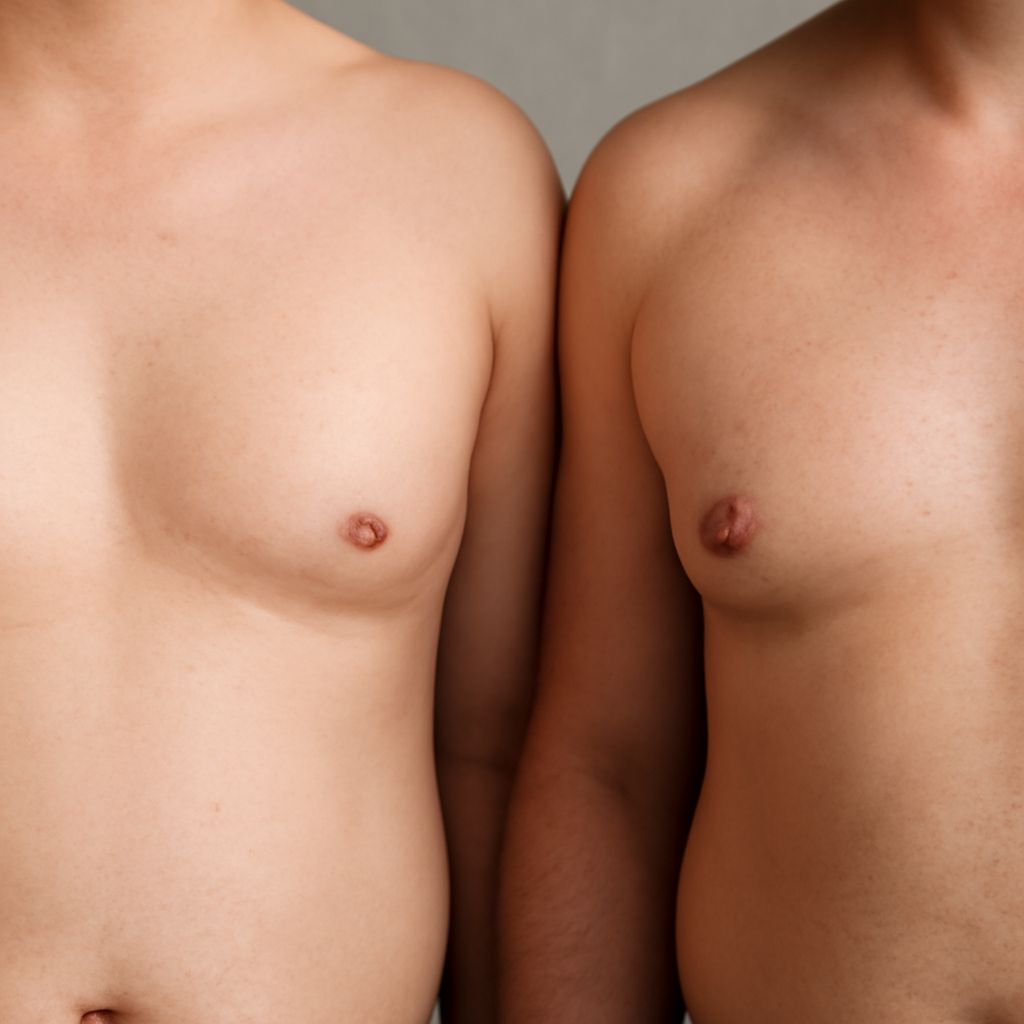
Gynecomastia vs fat shows up differently in appearance. Gynecomastia typically produces a more rounded, breast-like projection directly behind the nipple with clear demarcation at the areola. The nipple-areola complex may be slightly enlarged and the skin thicker in that zone. Chest fat is more diffuse, fills the entire pectoral area evenly, and lacks the defined nodular center of true gynecomastia. Men with both conditions—gynecomastia underneath combined with chest fat on top—have the most pronounced appearance and benefit from addressing both components.
Treatment: what works for each
Chest fat responds to calorie deficit and resistance training that builds the pectoral muscles underneath. As body fat percentage drops, chest fat reduces proportionally along with fat in other areas. Gynecomastia does not respond to diet or exercise because glandular tissue cannot be reduced through lifestyle changes. Mild gynecomastia from puberty may regress spontaneously within one to three years. Persistent gynecomastia after puberty rarely resolves without intervention. Medical treatment options include SERMs like raloxifene or tamoxifen (most effective when gynecomastia is less than two years old). Surgical options—subcutaneous mastectomy or liposuction with glandular excision—are the most reliable treatment for long-standing gynecomastia.
When to see a doctor
See a physician if you feel a firm nodule under the nipple that has been present for more than six months, if the tissue is growing, if there is nipple discharge, if only one side is affected, or if the onset was sudden rather than gradual. One-sided breast tissue growth or rapid development warrants evaluation to rule out less common causes. Most cases of gynecomastia or fat confusion resolve with a brief physical examination by a physician—it’s not a complex diagnostic process and knowing which condition you have allows appropriate treatment planning.
Pro tips recap: Press under the nipple to feel for a firm, rubbery disc—that’s gynecomastia. Soft, diffuse tissue throughout the chest is fat that responds to diet and exercise. See a physician if the firm nodule has been present for over six months or is growing. Don’t waste months in the gym trying to train away actual glandular tissue.
Related Posts

Lipedema or Just Fat: Understanding the Difference

Kung Hee Fat Choy: Exploring Nutrition and Fitness